Danish architect Louis Weisdorf says that he ‘specialises in versatility’ : he’s worked in almost every field of design, but it’s his lighting that we really admire. He uses moveable elements to create multifunctional pieces that always shield the eye from the glare of bare bulbs. His masterful ‘Multi-Lite’pendant lamp, recently released by Gubi, was first sketched in 1972 and consists of cylinder enclosed by two semi-spherical shade and a brass hoop.
the shades can be adjusted up and down to create four different configurations.
Sue Timney formed Timney-Fowler with Grahame Fowler in 1979 after she graduated from the Royal College of Art, and together the pair went on to create some of the design world’s most enduring and evocative prints. Graphic, bold and modern with twists on neo-classical, their work flowed from the world of interiors onto catwalks and back again, as they collaborated with big names such as Issey Miyake, Yohji Yamamoto and Diane von Furstenberg. The Fashion and Textile museum is celebrating the 30th anniversary of Timney-Fowler, and Sue’s career in design with a special retrospective – Sue Timney and The Design of Timney-Fowler.
So checkout our Q&A with Timney.
How would you describe your style? The most difficult question I can think of answering. Some key words would be graphic, disciplined, perhaps a sense of theatre. My influences are from so many areas of art and design history – the Renaissance, William de Morgan to Zaha Hadid as well as the street.
How do you approach a new design? With an open mind…
When you first launched Timney-Fowler, what inspired your designs? The biggest single element was travel. I was born in North Africa and travelled constantly as a child, so a lot of this experience came into the work that I did in those early days with Grahame Fowler.
And what tends to inspire them now? Everything, everyday. That’s what’s exciting, you never know where the inspiration is coming from. There is no doubt, though, that as a designer there is a huge advantage getting older as this inspiration becomes easier to translate into visuals.
What is it that makes your work so adaptable from fashion to interiors? Probably because I wasn’t originally trained as a designer – but as a fine artist, which in turn makes me probably look at things more laterally. But overwhelmingly too I’m not sure I believe in “boxes” of creative thought. One idea influences another – it’s just the way you approach it that changes.
How do you think design changed in the three decades you have been working in the industry? The biggest change for all of us in this industry has been the advance of technology without a doubt – for bad and good. It means I can network now with my team on a project, which in turn means I don’t run a huge studio (which I miss) – however it is more time efficient and it means I don’t have to be in London all the time (which I don’t miss).
What design are you most proud of? Definitely my four children, Alix, Louis, Max and Todd!
And aside from your own work, is there another design or designer you admire? I’m not sure I admire my own work, and it’s always a very hard to isolate one name as I’m daily in admiration of designers past and present. But Lucienne Day was an amazing designer and mark maker that I can relate to. Her fabrics and ceramic designs were unique and still feel contemporary. She was an independent woman who worked all her life because she believed in what she was doing.
What’s next? As well as the exhibition, I’ve also just launched a book so I’m travelling around the country and to New York to do signings. Meanwhile, I have been working with House of Fraser as it will be launching a Timney brand in the spring for home and fashion across many product areas – it’s very exciting.
What is your own home like? Well, there’s definitely black and white in it! But I am also a big collector and so I’ve got a lot of these collections from groups of ceramics to 20th century prints and boxes grouped in various places around the house. Justin [de Villeneuve], my husband’s work also has a prominent place as his past and current photography fits very well with my colours and wallpapers!
Describe your perfect room, fictional or otherwise. Somewhere I can relax and be happy with all my family – without them there is no perfect room.
I’m sure you have seen her face before, but not knowing this woman, and what is her story. Is she just a pretty face? Or has she got a darker life behind her angelic face. As we go back in time lets start with the creator.
Fornasetti (10 November 1913 – 9 October 1988) was an Italian painter, sculptor, interior decorator and engraver.
He lived most of his life in Milan, attending the Brera Art Academy from 1930-32 when he was expelled for insubordination. During World War II, he went into exile in Switzerland from 1943-46. He created more than 11,000 items, many featuring the face of a woman, operatic soprano Lina Cavalieri, as a motif. Fornasetti found her face in a 19th-century magazine. “What inspired me to create more than 500 variations on the face of a woman?” asks Italian designer, Piero Fornasetti of himself. “I don’t know,” he admits, “I began to make them and I never stopped.” The “Tema e Variazioni” (theme and variation) plate series based on Cavalieri’s face numbered more than 350.
Other common features in his work include heavy use of black and white, the sun and time. His style is reminiscent of Greek and Roman architecture, by which he was heavily influenced.
Today it is most common to see Fornasetti’s style in fashion and room accessories such as scarves, ties, lamps, furniture, china plates and tables and his son, Barnaba Fornasetti, continues to design in his father’s name.
Lina Cavalieri (25 December 1874 – 7 February 1944) was an Italian operatic soprano known for her great beauty. Cavalieri, born in Viterbo, Latium, Italy, she lost her parents at the age of fifteen and became a ward of the state, sent to live in a Roman Catholic orphanage. The vivacious young girl was extremely unhappy under the strict raising of the nuns, and at the first opportunity she ran away with a touring theatrical group. Blessed with a good singing voice, a young Cavalieri made her way to Paris, France, where her stunning good looks opened doors and she obtained work as a singer at one of the city’s café-concerts. From there she performed at a variety of music halls and other such venues around Europe while still working to develop her voice for the opera. A soprano, Cavalieri took voice lessons and made her opera debut in Lisbon, Portugal, in 1900, the same year she married her first husband, the Russian Prince Bariatinsky. Eventually she followed in the footsteps of Hariclea Darclée as one of the first stars of Puccini’s Tosca. In 1904 she sang at the Opéra de Monte-Carlo then in 1905, at the Sarah Bernhardt Theatre in Paris, Cavalieri starred opposite Enrico Caruso in the Umberto Giordano opera, Fedora. From there, she and Caruso took the show to New York City, debuting with it at the Metropolitan Opera on 5 December 1906.
During her career, Cavalieri sang with other opera greats such as the Italian baritone Titta Ruffo and the French tenor Lucien Muratore, whom she married in 1913. After retiring from the stage, Cavalieri ran a cosmetic salon in Paris. In 1914, on the eve of her fortieth birthday — her beauty still spectacular — she wrote an advice column on make-up for women in Femina magazine and published a book, My Secrets of Beauty. In 1915, she returned to her native Italy to make motion pictures. When that country became involved in World War I, she went to the United States where she made four more silent films. The last three of her films were the product of her friend, the Belgian film director Edward José.
Eventually Paolo d’Arvanni, Cavalieri returned to live with her husband in Italy. Well into her sixties when World War II broke out, she nevertheless worked as a volunteer nurse. Cavalieri was killed in 1944 during an Allied bombing raid that destroyed her home in the outskirts of Florence.
La Cavalieri’s discography is slim. In 1910, for Columbia, she recorded arias from Faust, Carmen, Mefistofele, La bohème, Manon Lescaut and Tosca, as well as the song, “Maria, Marì! (Ah! Marì! Ah! Marì!).” In 1917, for Pathé, the soprano recorded “Le rêve passé,” with Muratore.
She was painted by the Italian artist Giovanni Boldini (acquired by Maurice Rothschild) and by the Swiss-born American artist Adolfo Müller-Ury (1862-1947). The latter is now the property of the Metropolitan Opera House in New York, the gift of Nicholas Meredith Turner in memory of his wife the soprano Jessica Dragonette. Hers is the face that appears repeatedly, obsessively in Piero Fornasetti’s designs. Italian actress Gina Lollobrigida portrayed Cavalieri in the film The World’s Most Beautiful Woman. In 2004, a book was published authored by Paul Fryer and Olga Usova titled Lina Cavalieri -The Life of Opera’s Greatest Beauty, 1874–1944.
It was made by the il grande maestro, Gerrit Thomas Rietveld
Utrecht/Utrecht, 1888/1964
Gerrit Thomas Rietveld, born in Utrecht on 24 June 1888, seems possessed of two personalities, each so distinct that one might take his work to be that of more than one artist. The first personality is that seen in the craftsman cabinet-maker working in a primordial idiom, re-inventing chairs and other furniture as if no one had ever built them before him and following a structural code all of his own; the second is that of the architect working with elegant formulas, determined to drive home the rationalist and neoplastic message in the context of European architecture. The two activities alternate, overlap, and fuse in a perfect osmosis unfolding then into a logical sequence. In 1918 Rietveld joined the “De Stijl” movement which had sprung up around the review of that name founded the year before by Theo van Doesburg. The group assimilated and translated into ideology certain laws on the dynamic breakdown of compositions (carrying them to an extreme) that had already been expressed in painting by the cubists: the “De Stijl” artists also carefully studied the architectonic lesson taught by the great Frank Lloyd Wright, whose influence was widely felt in Europe at that time.
Collaborating first with Robert van’t Hoff and Vilmos Huszar, then with Theo van Doesburg and Cornelius van Eesteren, Rietveld soon became one of the most distinguished interpreters of the neoplastic message.
Among his most important works are:
the Schröder house at Utrecht (1924); the “Row Houses” at Utrecht (1931-34); the Dutch pavilion at the Venice Biennial (1954); the sculpture pavilion in the Rijksmuseum Kröller-Müller at Otterloo and the Van Gogh Museum in Amsterdam (1955). Out of his equally important furniture, Cassina has chosen for its own production: the “Red and Blue” (1918), the “Zig-Zag” (1934), the “Schröder 1” (1923), the “Utrecht” (1935)
Wall Flowers, A Painterly Approch To Fantastic Florals Brings A Breath Of Fresh Air To Any Room, The Most Incredible Chest Of 2 Drawers, Not Only Piece Of Deco But To Be Considered Like Persian Carpet, The Older It Gets More Pressious It Becomes.
Gladly To Announce That It’s Comming Soon ……..
Cabinets from the designer Ferruccio Laviani with sculptural unusual shape, equipped with doors, decorated by triangles, shaped to follow the geometrical front design. The frame, high or low, in oak or sandblasted oak is then tinted in the finishes of the collection. Different variants of the cabinet are available, all are based on the finish of triangles on doors, all in either oak with crossed grain, oak and brass or oak and glossy lacquered metals. The inner shelves are made from clear glass.
Cabinets are also available as a wall suspended version, too.
This uplifting design of the illusion coffee table was conjured up by master illusionist Christopher Duffy, Working with a concept of levitation and buoyancy. The up balloon coffee table/ Designer: London Duffy London’s design are idea-based,……The up balloon table is playful tropme l’oeil,giving the impression of glass table top suspended by gold and silver balloons and it comes in red as well.
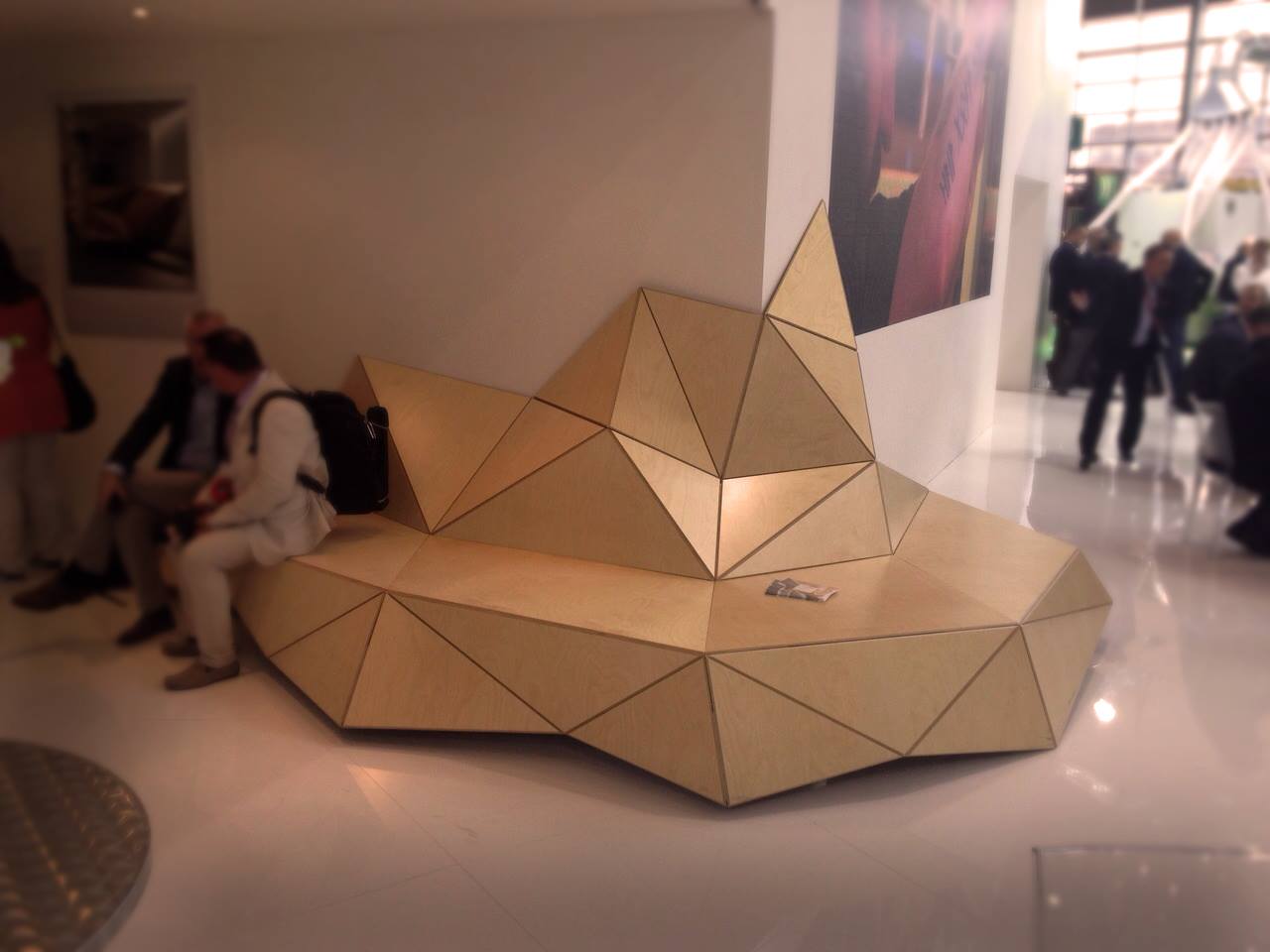
Imagine the world had actually turned out to be flat. Inconceivable. And how about your walls? Perhaps we should free them, too, from their planate constraints? Cue Wood-Skin. It’s a new, malleable composite material that can give architectural surfaces texture with a cool 3D effect. Wood-Skin is tissue-like, as flexible as fabrics but as rigid as wood, made of nylon mesh and triangular-shaped tiles. The faceted, computer-generated triangulation pattern allows it to be highly customizable. The wood skin bends where it creases.
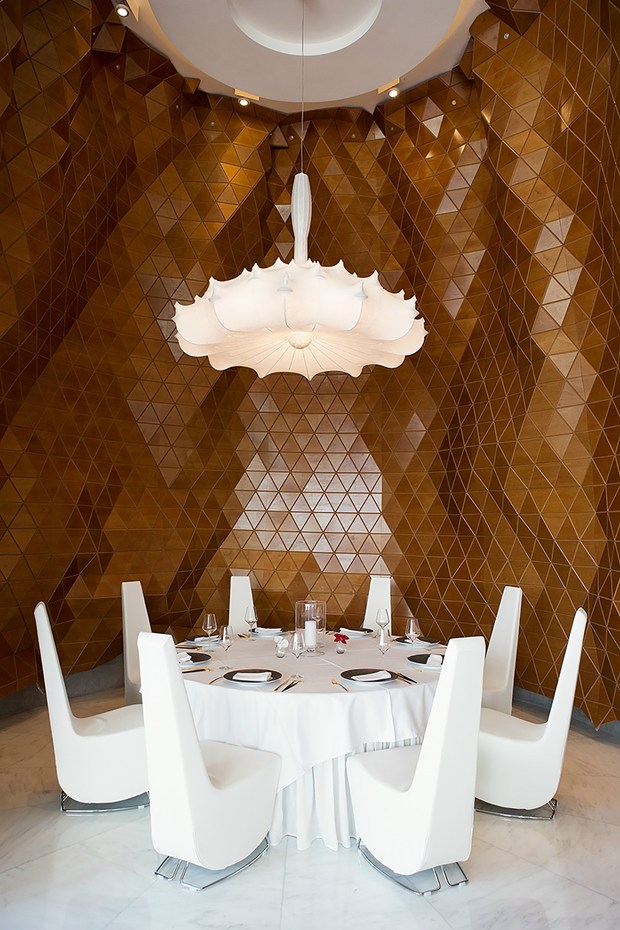
Wood-Skin can be used for a variety of applications, from self-standing flat structures like partitions, panels and walls to three-dimensional shapes like furniture (chairs, tables, shelves). It’s “programmable furniture” in the sense that 3D modeling technology allows companies to envision a skeleton of what their desired product would look like, while also figuring out the dimensions of the triangles – while consumers might get easy-to-assemble furniture straight of the box (shipped totally flat) with no assembly required.
The Milan-based company’s origami-like structural material is featured at Milan boutique Maison Margiela (it looks like marble curtains); also at Reign restaurant in Dubai (both with a walnut finish and shiny, black laminate); and on a Programmable Table in cooperation with MIT’s Self-Assembly Lab. The latter arrives completely flat and pops up into a stable piece of furniture without the need of any tools (see bottom image).
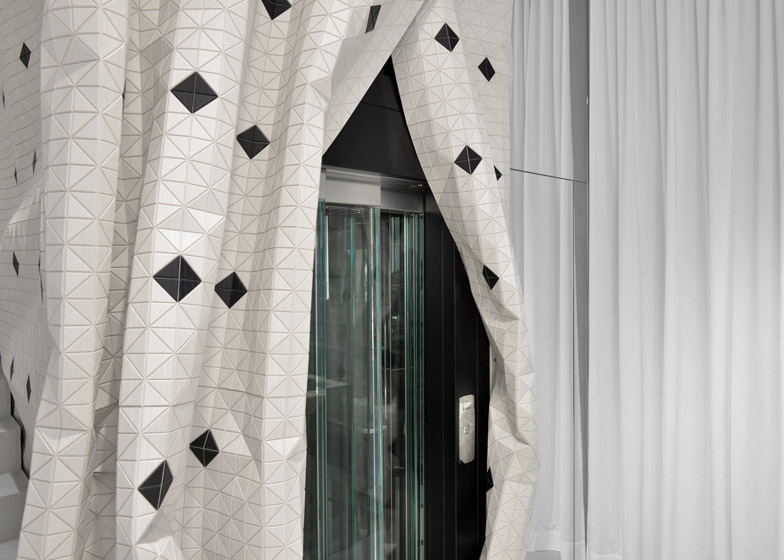
The good thing about Wood-Skin is that you can disassemble and re-use it as many times as you want without throwing it in the trash. You can fold our furniture up and store it under the bed when you’re not using it,” COO Susanna Todeschini told the Dublin Globe at the Web Summit 2015

Bosa trade present Jaime Hayon, So Who is he? Spanish artist-designer Jaime Hayon was born in Madrid in 1974. After studying industrial design in Madrid and Paris he joined Fabrica – the Benetton-funded design and communication academy in Italy- in 1997 where he directed the design department until 2003. Hayon set up his own studio practice in the year 2000 and dedicated himself fully to his personal projects from 2003 onward, today he is one of the most acclaimed creators worldwide.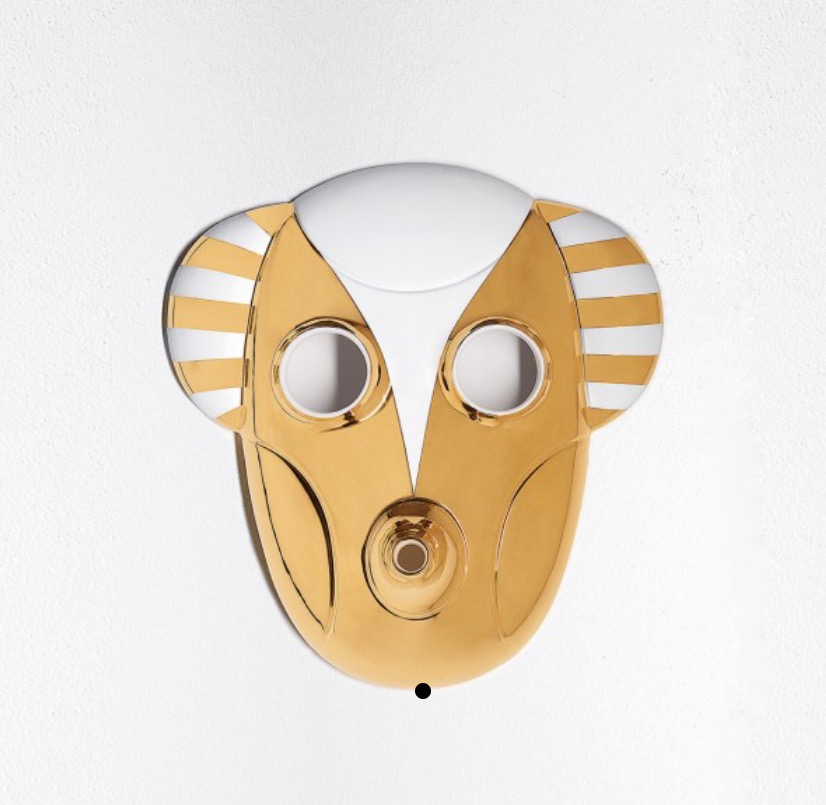
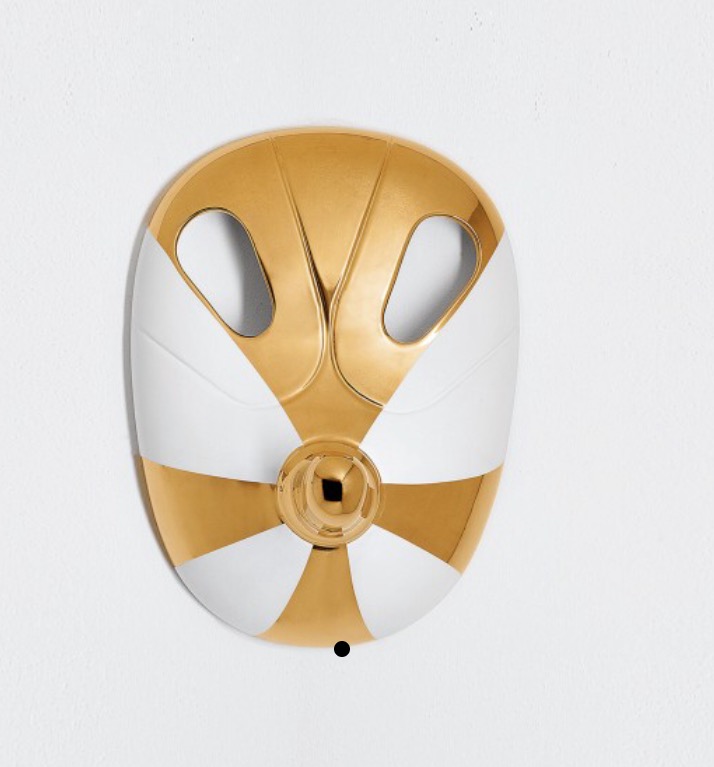
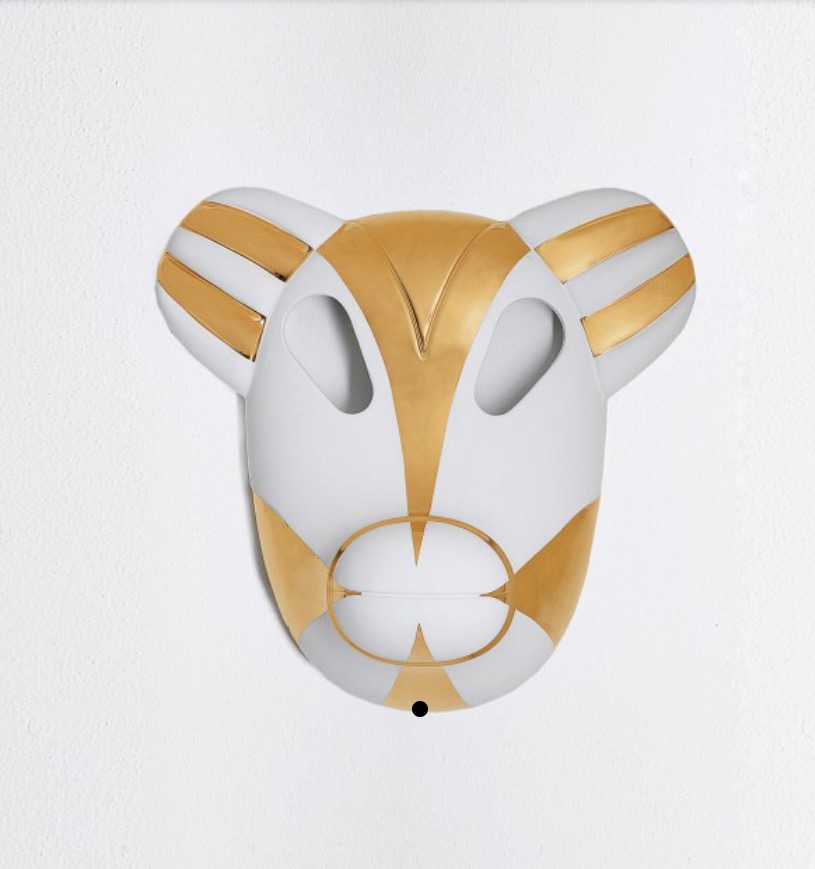
These are one of many pieces of art that are a must have, I must say it reminds me of the Inca masks. As you know the Inca masks are a tradition in Peru that has been around for centuries, it is part of the inca culture. Facial shapes, various embellishments, rich colors, lines and shapes decorating the forms. They can be found in many materials such as gold, silver, ceramic and even two of them have mixed materials. I love the material the color and they come in sets of three, something to collect and stay forever; great investment.

We are one of the leading sources of branded furniture and accessories that are fresh and innovative and sometimes crazy. All our partners are recognised brands from Europe or North America, known for their quality and innovation.


See below key events coming up. There are more events at out events page. Contact us to list your event.

20 - 24 January 2017, Paris

14 - 17 March 2017, Dubai

14 - 17 November 2017, Dubai